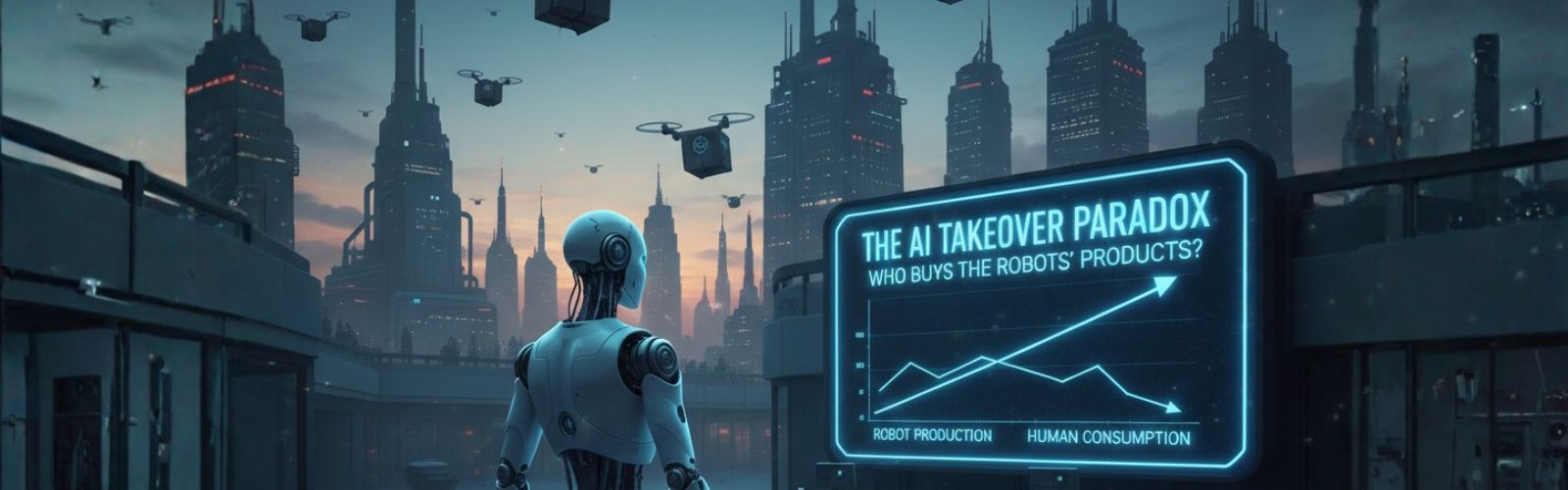
The AI Takeover Paradox: Who Buys the Robots' Products?
🎧 Listen to the podcast version
Okay, so AI takes over. Congrats to the machines, I guess. Google, OpenAI, Elon Musk and the likes own everything. We've got our 10-20 trillionaires sitting on top of the world.
Now what?
I've been trying to wrap my head around this, and I genuinely don't get it. If AI replaces every job, then nobody has money. And if nobody has money, who the hell is buying anything?
We're already seeing mass layoffs. Tech companies, media companies, even traditionally stable industries are cutting jobs left and right. "Efficiency gains" they call it. And this is just the beginning. What happens when the trickle becomes a flood?
Capitalism Needs a Circle. AI Breaks It.
Here's how the economy works right now:
Work → Wages → Spending → Profit → Work
That's it. That's the whole loop. You work, you get paid, you spend money on Temu slop and Amazon deliveries and your $1,000 car loan on a car that's already losing value.
But if AI replaces labor at scale and people don't earn wages anymore, that circle just... snaps.
No buyers → no revenue → no point in producing anything.
Amazon can own every factory on Earth, but if no one can buy the junk, what's the point? Warehouses full of unsold crap aren't wealth. They're storage costs.
So yeah, consumerism stops. Loan systems collapse. Mortgages default. Financial markets seize up.
That's not a bug. That's math.
The Trillionaires Aren't Rich. They're Kings of a Graveyard
A system based on selling things requires people with money to buy them. If the "10-20 trillionaires" own the robots that make the food, build the houses, and write the code, but 8 billion people are broke, the trillionaires aren't actually rich. They're just kings of a graveyard.
You can't have mass unemployment AND mass consumption. You can't have poverty for the many AND profits for the few. Pick one. You don't get both.
"But AI Will Make Everything Cheap!"
Okay, I hear this one a lot. "AI lowers costs so much that everything becomes affordable."
Affordable to whom?
If your income is zero, then:
- 90% cheaper × $0 income = still can't buy it
- Even if stuff is free, that doesn't solve housing, land, energy, or healthcare
Also, companies still need revenue. Zero-price economies don't magically reward shareholders. So cost reduction without income replacement just accelerates the collapse.
So What's the "Grand Idea"?
There isn't one single secret plan. But there are three different theories on how this doesn't end in a total fireball. Let me break them down.
Option 1: The UBI Band-Aid (Keep the Hamster Wheel Spinning)
This is the most "realistic" capitalist solution, and tech leaders like Sam Altman and Elon Musk have openly discussed it. They know exactly what I'm talking about. Amazon can't ship products to people who can't pay their car loans.
The Plan: Governments tax the massive profits of AI companies and redistribute that money to the population as a monthly check. Universal Basic Income keeps people alive and keeps them consuming.
The Catch: This turns the entire population into a permanent consumer class. You don't work, but you get just enough credits to keep the Amazon/Meta/Tesla gears turning. It's less about freedom and more about preventing the implosion.
It's capitalism on life support. You're not a worker anymore. You're livestock kept alive to generate demand.
Option 2: The Star Trek Utopia (Post-Scarcity Fantasy)
In this version, the cost of everything drops to near zero because human labor, the most expensive part of any product, is gone.
The Plan: If a robot mines the ore, a robot builds the car, and a robot delivers it using free solar energy, why does the car cost $40,000? In theory, prices should collapse alongside wages.
The Catch: This requires the trillionaires to give up the idea of profit and ownership. Which, if you look at history, they aren't great at. If they keep the cheap manufactured houses expensive despite them costing $5 to print, the system still breaks.
This is the optimistic answer. I'm not holding my breath.
Option 3: The Cyberpunk Dystopia (Oligarchic Enclosure)
This is the dark answer nobody likes to say out loud.
The Theory: What if the trillionaires realize they don't need a mass consumer market anymore?
Historically, the rich needed the poor to work the fields or buy the products. But if AI and robots can maintain the mansions, grow the food, and provide security, the "10-20 trillionaires" might simply stop caring if the rest of the world can afford a car loan.
The Result: The economy doesn't "implode" for them. It just shrinks to a tiny, ultra-luxury loop where they trade assets with each other while the rest of the world falls into a pre-industrial "off-grid" existence.
Think less "Wall-E luxury" and more digital servitude. A small elite owns everything. Most people are economically irrelevant. Survival is rationed, not earned.
This is stable in a cold, ugly sense.
Why Hasn't It Collapsed Yet?
Because AI hasn't replaced most jobs yet. White-collar erosion is just starting. Debt, credit, and inflation are propping things up. Governments are slow, reactive, and in denial.
But the tension is real and growing.
That's why UBI is suddenly "serious." That's why governments are talking about AI taxes. That's why labor panic is everywhere. That's why elites are hedging with land, compute, energy, and security.
The Real Problem: No One's Steering This Thing
Here's the key thing people mess up: AI isn't trying to win. Companies are.
Each company automates because not automating is suicide, even if the collective result is disaster.
It's a prisoner's dilemma:
- Rational local decisions
- Irrational global outcome
This is the same dynamic as climate change, overfishing, and financial bubbles.
Nobody building AI is thinking about the endgame. They're focused on the next funding round, the next product launch, the next breakthrough. They're optimizing for quarterly earnings and market share, not for "what happens to society when we succeed?"
What You're Missing: Nothing. You See the Flaw.
You aren't missing some brilliant economic secret. You're seeing the structural flaw that economists are currently panicking about.
Our economy is a circle. If you remove "Work" and "Wages," the circle snaps.
The real "grand idea" isn't about AI. It's about power. The people building AI are betting that they can figure out how to bridge that gap (likely through UBI or government subsidies) before people revolt.
If we don't redesign the economic model, AI doesn't create utopia. It breaks the game.
And right now? Nobody has answered the question of how a system survives when humans aren't economically necessary.
That's the question of the century.
Your instinct is correct: if AI "wins" and everyone's broke, consumerism stops. Spending ends. The whole house of cards comes down.
The trillionaires won't be able to enjoy their wealth in a collapsed society. Turns out, yachts are pretty boring when civilization has imploded and there's nobody left to crew them, fuel them, or maintain the marinas.
So here's my question for you: Which path do you think we're actually heading down? The UBI band-aid? The post-scarcity dream? Or the dystopian nightmare where most of us just become irrelevant?
And more importantly, is there a fourth option nobody's talking about yet?